Kabaddi is seven a side, played on a court smaller than a badminton hall, with no ball and no equipment at all.
One player crosses into the opposition half to touch defenders and get back, while seven try to hold them.
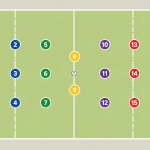
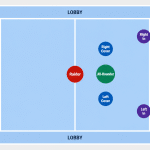
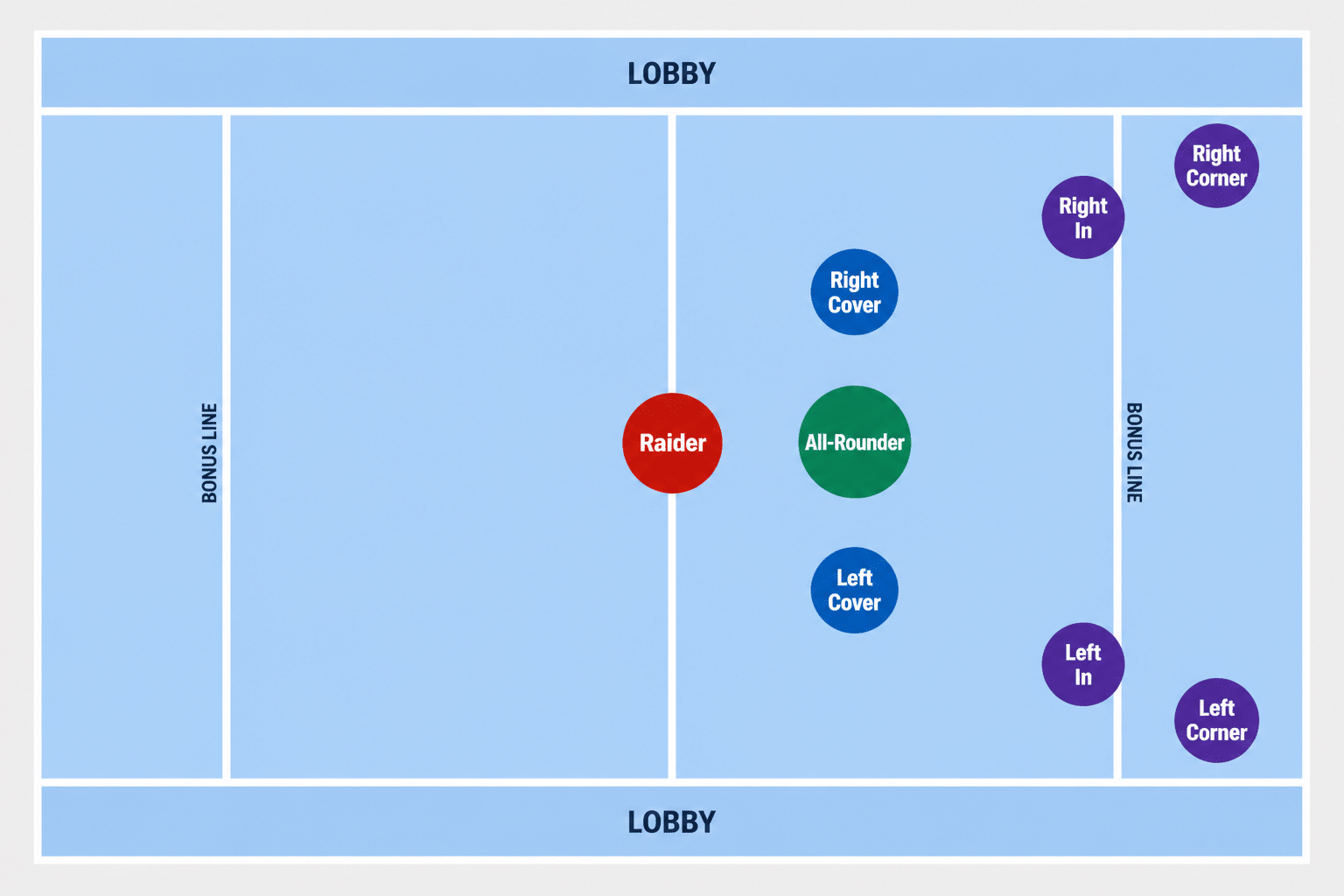
The positions are all defined by where a player stands in that defensive chain, and by what they are expected to do when the raider comes.
- The Raider is the only attacking player, and scores by touching defenders and returning across the midline.
- The Corners stand at the back of the court and make the ankle holds.
- The Covers stand ahead of them and are the first line of contact.
- The Ins defend the middle and support both sides of the chain.
- An All-Rounder both raids and defends, which is the most valuable player in a squad of twelve.
#1 Raider
The raider crosses the midline alone, must keep up a continuous chant, touch at least one defender and return to their own half before the breath, or the thirty second clock, runs out. Every point the attacking team scores comes from this one player.
Raiding is a matter of decisions, not just speed. A raider reads which defender is out of position, uses the bonus line when the defence is strong, and knows when to take nothing at all rather than risk being caught. Getting out costs a point and reduces the team on court.
Key Characteristics or Skills:
- Explosive change of direction inside a small court.
- Escape moves such as the toe touch, the running hand touch and the frog jump.
- Breath control and stamina, since the raid ends when the chant does.
- Reading which defender will commit first.
#2 Left Corner and Right Corner
The two corners stand at the back of the defensive half, closest to the end line. They are the last defenders a raider passes and the ones with the least room behind them.
Corner defenders specialise in the ankle hold, dropping low to catch the raider’s foot as they turn for home. It is the highest risk tackle in the sport, because a corner who commits and misses leaves the whole back of the court open, and corners are usually the players the opposition targets first.
Key Characteristics or Skills:
- The ankle hold, timed as the raider turns.
- Low body position and hip strength.
- Patience, since a corner who moves early is beaten.
- Recovery speed after a failed hold.
#3 Left Cover and Right Cover
The covers stand between the corners and the middle of the court, and they are usually the busiest defenders in the team. They make first contact with a raider who comes down the side and they support the corner behind them.
The signature tackle here is the thigh hold or the block, stopping the raider’s momentum rather than catching a limb. Covers also work in pairs with their corner: one initiates, the other completes, and most successful tackles in modern kabaddi involve two defenders rather than one.
Key Characteristics or Skills:
- The thigh hold and the body block.
- Coordination with the corner on the same side.
- Upper body strength to stop a moving raider.
- Anticipation of which way the raider will break.
#4 Left In and Right In
The ins defend the middle of the court, closest to the midline. They face the raider first and often have the shortest reaction time of anybody in the chain.
Because they are nearest the line, ins are usually the players who also raid. Many teams field their all-rounders here, so the position combines the ankle and thigh holds of a defender with the escape skills of an attacker.
Key Characteristics or Skills:
- Quick reactions in the smallest available space.
- The ability to raid as well as defend.
- Holding the chain together when a corner is drawn out.
- Strength in the dash, where defenders push the raider out over the sideline.
#5 All-Rounder
An all-rounder both raids and defends at a high level, which in a sport of seven players is worth more than any single specialist. They allow a coach to keep a strong defensive chain on court without losing raiding power.
The role matters most in the endgame. When a team is reduced to two or three players, the all-rounder is the one who can both survive a raid and go on the attack, and matches are regularly decided by exactly that situation.
Key Characteristics or Skills:
- Competence in both halves of the game rather than excellence in one.
- Fitness, because they are on court for the whole match.
- Decision making when the team is short of players.
- The versatility to fill a gap left by a substitution.
How the Kabaddi Defensive Chain Works
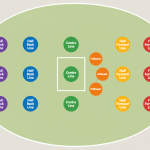
Kabaddi defenders are named by where they stand, and the seven positions form a chain across the court. This is the standard arrangement, seen from behind the defending team.
| Position | Where they stand | Signature tackle |
|---|---|---|
| Left Corner | Back left of the defensive half | Ankle hold. |
| Left In | Left side, near the midline | Block and dash. |
| Left Cover | Between the left corner and the middle | Thigh hold. |
| Centre | The middle of the chain, often an all-rounder | Support tackle and chain hold. |
| Right Cover | Between the right corner and the middle | Thigh hold. |
| Right In | Right side, near the midline | Block and dash. |
| Right Corner | Back right of the defensive half | Ankle hold. |
When a defender is touched they leave the court, and the chain has to reform with fewer players. That is why a raider who takes out one corner has really taken out the whole side of the court.
Hybrid Positions
Bonus Raider
A raider who specialises in taking the bonus point by crossing the bonus line with a raised leg, rather than risking a touch. Low risk, and often decisive over a full match.
Do or Die Raid
The third raid in a row without a point must produce one, or the raider is out. Teams often send a different player, which makes the do or die raider a role of its own.
Super Sub
A substitute brought on specifically for a defensive or raiding phase. Kabaddi allows substitutions during breaks, and squads carry twelve players for exactly this.
Kabaddi is a tag and wrestle game with no ball at all. For another sport built entirely around blocking and getting past defenders, see our guide to roller derby positions and roles.
FAQ
What are the positions in kabaddi?
A kabaddi team of seven has a raider plus defensive positions: left corner, right corner, left cover, right cover, left in and right in. Players who both raid and defend are called all-rounders.
What does a corner do in kabaddi?
A corner in kabaddi stands at the back of the defensive half and specialises in the ankle hold, catching the raider by the foot as they turn to run back across the midline.
How many players are in a kabaddi team?
Seven players from each team are on the court at a time, from a squad of twelve. Players who are touched or tackled leave the court and are revived when their team scores.
Conclusion
Kabaddi gives every position a place in a chain and then tests that chain one raid at a time.
Corners take the biggest risks, covers do the most work and ins face the raider first.
The raider is alone against seven and still scores most of the points, which is what makes the sport so watchable.
All-rounders decide close matches, because a team reduced to three players needs someone who can do both jobs.
Learn the seven names and the whole tactical picture of a raid opens up in the first two seconds.