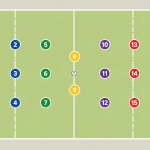
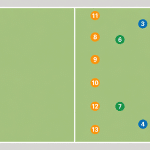
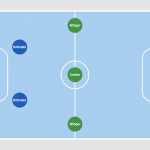
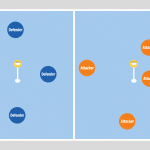
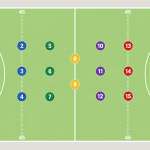
Korfball is the only major team sport where mixed gender teams are the standard rather than the exception, with two men and two women in each half of the court.
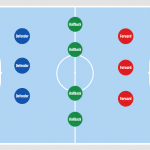
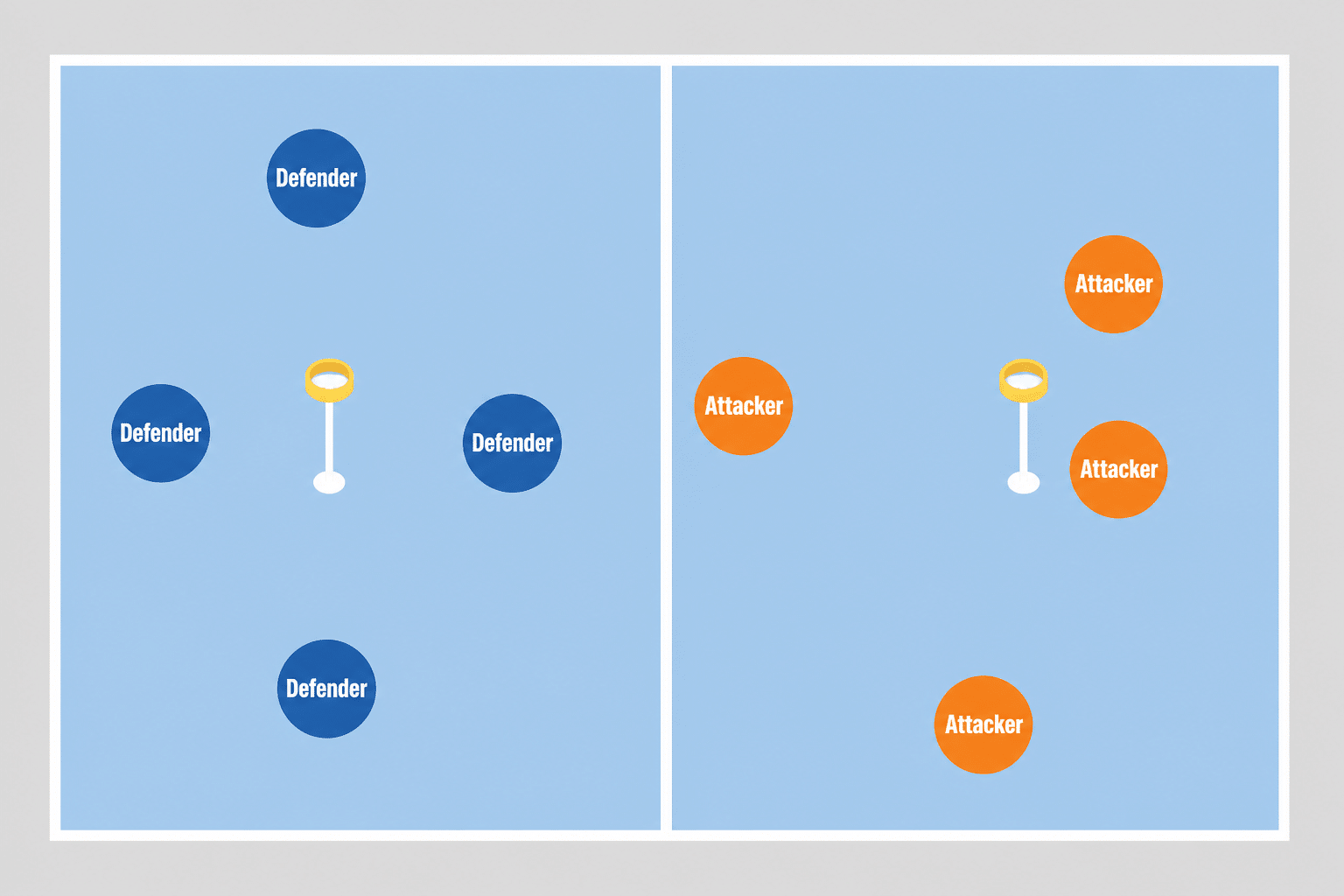
A team of eight is split down the middle: four players attack, four defend, and they swap roles after every two goals.
That rotation is why korfball has so few named positions and so much positional thinking.
- The Attacker plays in the zone with the ball and tries to shoot past a defender who is allowed to block.
- The Defender guards one opponent of the same gender and must stay within arm’s reach to stop a shot legally.
- Every player becomes both, because attackers and defenders switch after every two goals.
- There is no dribbling and no running with the ball, so movement without it decides everything.
- Teams are four men and four women, and defending is always same gender.
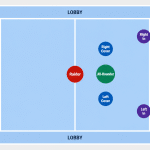
#1 Attacker
Four players make up the attacking division and stay in the half of the court that holds their target post. Because a player cannot run with the ball or dribble, an attacker either shoots, passes or stands still, which makes movement off the ball the whole game.
A shot only counts if the shooter is not defended, meaning the defender is not within arm’s reach, facing them and actively trying to block. Getting free from that definition, even for half a second, is what attacking in korfball actually consists of.
Key Characteristics or Skills:
- Shooting from distance with a two handed set shot.
- Getting free without the ball, since a marked shot does not count.
- Quick, flat passing to a moving teammate.
- Reading when to take the shot and when to reset the attack.
#2 Defender
The other four players defend the half of the court containing the opposition’s post. Each defender picks up one attacker of the same gender and stays with them, because defending across genders is not allowed under korfball rules.
Defending is legal blocking rather than intercepting. Standing close, facing the attacker with a raised arm is what makes a shot invalid, so korfball defence rewards discipline and endurance far more than it rewards gambling for the ball.
Key Characteristics or Skills:
- Staying within arm’s reach for the length of an attack.
- A raised blocking arm that makes the shot count as defended.
- Footwork to follow an attacker who never carries the ball.
- Boxing out at the post, since a missed shot is live for both teams.
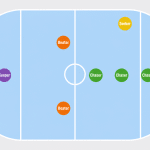
#3 Shooter
Not a fixed position but a recognised job. Most teams have one or two players who take the long shots, and the whole attack is arranged to create the half second of space those players need.
A specialist shooter in korfball is measured on the long distance shot from outside the defensive pressure, which is the hardest and most valuable score in the sport. Everything else is built to create the moment where that shot is unmarked.
Key Characteristics or Skills:
- A repeatable long shot under fatigue.
- The patience to wait for the block that frees them.
- Balance, because the shot is taken with both feet planted.
- Nerve, since the shooter is the player the defence prepares for.
#4 Runner
The runner is the attacker who plays close to the post and takes the ball on the move towards it. The classic korfball score from this role is the running in shot, where a player receives the pass while already moving under the basket.
A runner needs a partner who can time the pass precisely, because the ball has to arrive exactly as the runner cuts free of the defender. It is the closest thing korfball has to a give and go.
Key Characteristics or Skills:
- Timing the cut so the defender is beaten before the pass leaves.
- Catching and shooting in one motion.
- Reading the passer, since the runner cannot slow down to adjust.
- Repeating the run without the ball, over and over, to pull the defence apart.
#5 Rebounder
The rebounder is the attacker who takes position beneath the post to collect missed shots. A korfball post has no backboard, so rebounds fall almost vertically and position matters more than height.
The role also has a defensive half. When defending, the same player has to box out their opponent to stop them collecting the rebound, and because divisions swap every two goals, most players do both jobs within a few minutes of each other.
Key Characteristics or Skills:
- Position under the post before the shot is taken.
- Reading the drop of the ball off a post with no backboard.
- Strength to hold ground legally against a same gender opponent.
- A fast outlet pass to restart the attack.
How Korfball Divisions and Switching Work
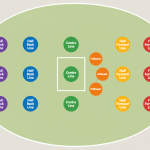
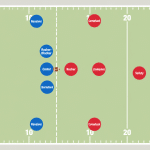
Korfball has no numbered positions. Instead the eight players are split into two divisions of four, and the rules move them around the court in a fixed pattern.
| Rule | What it means | Why it matters |
|---|---|---|
| Two zones | The court is split in half, each with one post | Players may not cross into the other zone during play. |
| Four and four | Two men and two women in each zone | Every division is mixed, and defending is always same gender. |
| Switch every two goals | Attackers become defenders and defenders become attackers | No player specialises for long, so everyone must do both. |
| No dribbling | A player with the ball may not run with it | Attacking is built entirely on passing and movement off the ball. |
| Defended shot | A shot with a defender within reach and blocking does not count | Getting free is more important than shooting range. |
The switching rule is what makes korfball unusual. A player who has just spent two goals blocking shots is now the one trying to get free, against an opponent who has just done the same thing in reverse.
Hybrid Positions
Feeder
The attacker who holds the ball at the top of the zone and distributes it. Rarely shoots, and is usually the player who sees the whole attack develop.
Long Shooter
A player used almost exclusively for distance shooting when the defence sits deep. Their presence forces defenders further from the post.
Substitute
Korfball substitutions are limited, so a bench player is usually brought on to change one specific matchup rather than to rest the team.
Korfball grew out of a Dutch school game that deliberately removed the physical advantages of basketball. To see how the same idea of a ball, a hoop and five positions developed differently, read our guide to basketball positions and roles.
FAQ
What are the positions in korfball?
Korfball has two divisions rather than fixed positions: four attackers and four defenders. Within the attack, players take on the roles of shooter, runner, feeder and rebounder, and attackers and defenders swap after every two goals.
How many players are on a korfball team?
A korfball team has eight players on court, four in each zone, made up of four men and four women. Defending is always between players of the same gender.
Why do korfball players switch positions?
Korfball switches its attacking and defending divisions after every two goals so that no player specialises in only one half of the game, which keeps the sport balanced and means every player has to both shoot and defend.
Conclusion
Korfball replaces named positions with divisions, and then keeps moving players between them so nobody stays specialised.
The rules against dribbling and against shooting when defended turn the sport into a game of movement rather than of ball handling.
Attacking roles like shooter, runner and rebounder exist inside the division, but everybody plays all of them within a single match.
The mixed gender structure is not a novelty. It shapes the defensive matchups and therefore the tactics on every possession.
Learn the switching rule first, and the rest of korfball follows from it.