Ten wetsuits for paddle boarding compared on neoprene thickness, cut and how much movement each one leaves in the shoulders.
Paddling is a shoulder sport done above the water, so the suit that works under a board is rarely the one a diver would pick. Everything below is in stock, and every figure comes from the maker: thickness, seam type, zip position and the water temperature the suit is rated for.
The best paddle board wetsuit: ten picks at a glance
Choosing the best wetsuit for paddleboarding comes down to three decisions. How cold the water is, which sets the thickness. Whether you want sleeves at all, because a shorty leaves the shoulders completely free. And where the zip sits, since a back zip is easy to get into alone while a chest or front zip flushes less when you fall in.
Below you get the short version first: the picks for the most common cases, then the full table with all ten, then every suit in detail with material, cut and the trade it asks for.
- The safe choice for cool waterO'Neill Reactor-2 3/2mm
- Least water down the neck when you fallHyperflex VYRL 3/2mm
- Warm days with the shoulders freeO'Neill Reactor-2 2mm Spring
- The cheapest full suit hereLemorecn 3/2mm


| Wetsuit | Cut | Thickness | Entry | Best for |
|---|---|---|---|---|
| O'Neill Men's Reactor-2best overall | full suit | 3/2mm | back zip | Cool water and long sessions |
| Hyperflex VYRLbest chest zip | full suit | 3/2mm | chest zip with head gusset | Falling in without a flush |
| O'Neill Women's Reactor-2best women's full suit | full suit | 3/2mm | back zip | The same suit in a women cut |
| AKONA 3mm Quantum Stretchmost stretch | full suit | 3mm | back zip | Water between 70 and 85 F |
| Hevto Men's 3/2mmbudget full suit | full suit | 3/2mm | back zip | Water between 57 and 72 F |
| Dark Lightning Women's 3/2mmbudget women's full suit | full suit | 3/2mm | back zip | Water between 58 and 68 F |
| Lemorecn 3/2mmbest budget | full suit | 3/2mm | back zip | A first full suit |
| O'Neill Reactor-2 Springbest men's shorty | short sleeve spring | 2mm | back zip | Warm days with free shoulders |
| Gill Women's Pursuit Shortybest women's shorty | shorty | 3/2mm zoned | back zip | Summer paddling in a sailing cut |
| Cressi Tiburonlightest | short sleeve one piece | 1.5/2mm | front zip | Warm water and sun protection |
The ten wetsuits for paddle boarding in detail
- Cutfull suit
- Thickness3/2mm
- Materialultra stretch neoprene
- Entryback zip with a water resistant closure
- Shouldersseamless paddle zones
- Extrawind resistant smoothskin panels
Best for: Paddlers in cool water who want one suit for the whole season and get changed alone
This is the default answer for paddle boarding in cool water. The suit is built around minimal seam placement through the shoulder and chest, which is the one region a paddler loads on every stroke, and the ultra stretch neoprene keeps the arm swing free rather than springing back at the top of the stroke.
The second reason to pick it is wind. On a board you are out of the water and in the breeze the whole time, and the smoothskin panels are the part that keeps a wet suit from turning into a cooling jacket. The back zip is the compromise: easy to close alone, but it lets in more water when you go over the side than a chest zip does.
Pros
- The seamless paddle zones sit exactly where a paddle stroke loads the suit, so the shoulders do not fight back
- Wind resistant smoothskin matters more on a board than in the water, because you spend the session in the wind
- A back zip is the entry you can operate without a second person
- O'Neill sizes this suit in tall and wide fits, not only in standard sizes
Cons
- It costs roughly twice what the budget full suits here cost
- A back zip flushes more than a chest zip when you fall in
- 3/2mm is too much suit for a warm summer afternoon
- Cutfull suit
- Thickness3/2mm
- MaterialQuantum Foam neoprene
- Liningmicrofleece, fast drying
- Entrycocoon chest zip with an anti-flush head gusset
- SeamsGBS sealed, GlideSkin collar
Best for: Anyone who falls in often and wants the least water down the neck
The VYRL is the suit to buy if the back zip is what bothers you. Entry is through a chest zip with a gusset that folds over the head opening, and the effect is a suit that does not fill up the moment you go over the nose of the board.
Everything else is a step up from the budget end rather than a different idea. Sealed and glued seams instead of flatlock stitching, a GlideSkin collar that seals without rubbing, and a microfleece lining that both insulates and dries quickly. You pay for those three things, and in cold water they are the three that show.
Pros
- The anti-flush head gusset is the detail that stops the cold rush a back zip lets through
- A microfleece lining dries fast, which matters when the suit goes back on the next morning
- GBS sealed seams are glued and blind stitched, a step above the flatlock seams on the budget suits here
- Quantum Foam is light, so the suit does not hang on you between sessions
Cons
- Chest entry takes practice and is harder to get into than a back zip
- It is the second most expensive suit in this list
- Stock on single sizes runs thin

- Cutfull suit, women pattern
- Thickness3/2mm
- Materialultra stretch neoprene
- Entryback zip with a water resistant closure
- Shouldersseamless paddle zones
- Extrawind resistant smoothskin panels
Best for: Women who want the same construction as the men's Reactor-2 in a cut that actually fits
Buying a mens suit one size down is the usual mistake, and it is the reason so many wetsuits leak: the torso is too long and water sits in the folds. This is the same Reactor-2 build in a women pattern with published measurements per size.
What you get is the construction from the top pick: seamless paddle zones through the shoulders, smoothskin against the wind and ultra stretch neoprene that keeps the arms free. The compromise is the same too, a back zip that is easy to close alone and lets more water in than a chest entry.
Pros
- Identical construction to the top pick here, so the seam layout and the smoothskin panels carry over
- A women specific pattern means the torso length is right, which is what decides whether a suit flushes
- Numbered sizing with published chest, waist and height ranges takes the guesswork out
- Rated by O'Neill for surfing, diving and paddle sports rather than for one of them
Cons
- Same price bracket as the mens version, which is above every budget suit here
- Back zip entry, so the same flush compromise applies
- Only sold in black in this listing

- Cutfull suit
- Thickness3mm throughout
- Materiallimestone based Quantum Stretch neoprene
- Stretch300 percent more than standard neoprene by the maker
- Rated forwater between 70 and 85 F
- Sizesup to 5XL
Best for: Warm water paddling where you still want full coverage against sun and jellyfish
AKONA built this one for warm water, and that changes what the thickness means. 3mm all over, including the arms, gives even coverage against sun, jellyfish and wind, and the Quantum Stretch neoprene is what keeps that even thickness from stiffening the stroke.
It is also the environmentally cleaner suit in this list, because the neoprene is limestone based rather than petroleum based. Take the temperature rating seriously: below 70 F this is not enough suit, and above it the stretch is the best of anything here.
Pros
- 300 percent more stretch than standard neoprene is the largest claim in this list, and it shows in the arms
- Limestone based neoprene instead of petroleum based, which is the more environmentally sound of the two
- Sizes run to 5XL, further than any other suit here
- Armortex knee pads survive kneeling on a rough deck pad
Cons
- Rated only from 70 F, so this is not a cold water suit
- 3mm on the arms is more material than a 3/2mm suit puts there
- At around 200 dollars it is priced with the premium suits while covering the warmest water

- Cutfull suit
- Thickness3/2mm
- Materialneoprene with a nylon elastic face
- Rated forwater between 57 and 72 F
- Entryback zip with a lengthened pull
- Colorred and black
Best for: A first full suit for spring and autumn paddling without spending premium money
Hevto sells this suit on one honest number: 57 to 72 F. That is the window it works in, which covers spring and autumn paddling in most temperate places and nothing colder.
For the money the construction is straightforward rather than clever. 3mm through the body and 2mm on the limbs, a nylon face over the neoprene, a back zip with a long pull. It does not have sealed seams and it does not pretend to. As a first full suit, or a spare you keep in the car, it does the job.
Pros
- A stated water temperature window, 57 to 72 F, which most suits at this price do not publish
- Costs about half of the premium full suits here for the same 3/2mm layout
- The lengthened zip pull makes solo entry workable
- Nylon faced neoprene resists snagging on deck fittings
Cons
- Flatlock construction rather than sealed seams, so it flushes more in cold water
- Sizing runs tight by design and there is little room to adjust
- The neoprene is stiffer than the premium suits, which you feel late in a session
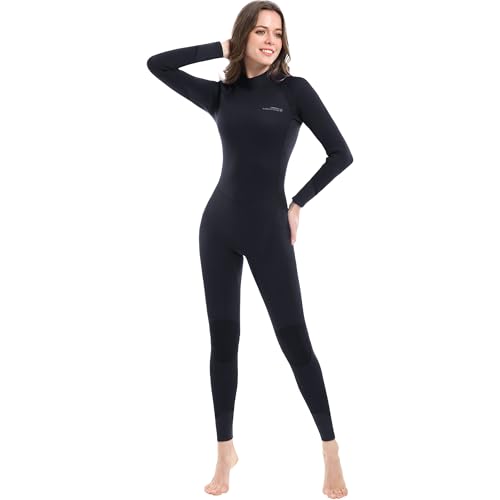
- Cutfull suit, women pattern
- Thickness3/2mm
- Materialhigh elasticity neoprene
- Rated forwater between 58 and 68 F
- Entryback zip with an extended leash
- Styleall black with minimal branding
Best for: Women who paddle in spring and autumn and do not want to spend premium money on a first suit
This is the budget counterpart to the O'Neill women suit above. Same 3/2mm layout, same back zip idea, and a published window of 58 to 68 F that puts it firmly in spring and autumn rather than winter.
The maker rebuilt the size chart after customer feedback, which is worth knowing: order from the current chart, not from memory or from another brand. Within its temperature window it does what a paddler needs, keeps the core warm and leaves the arms alone.
Pros
- A published temperature window of 58 to 68 F, so you know before you buy what it is for
- The extended zip leash makes closing it alone straightforward
- High elasticity neoprene keeps the shoulder from binding at the top of a stroke
- Costs roughly a third of the premium women full suits here
Cons
- Flatlock seams rather than sealed ones, so it is not a cold water suit
- The size chart was reworked, so ordering by an older chart will give you the wrong fit
- Nothing in the listing about wind resistant panels, which a board rider notices
- Cutfull suit
- Thickness3mm chest panel, 2mm limbs
- Rated forwater from 55 F upward
- Entryback zip with a long pull rope
- Sealadjustable glide skin neck seal
- Extrasanti-abrasion knee pads, UV 50+, YKK 10 metal zip
Best for: Anyone who wants a working full suit for the price of a paddle leash and a pump
The Lemorecn is the price floor of this list and it does not cut the parts that break. A YKK metal zip, an adjustable glide skin neck seal and knee pads that survive a deck pad are the three things a cheap wetsuit usually gets wrong.
What it gives up is seam sealing. Stitched seams let water move through the suit, which is fine at the top of its 55 F rating and unpleasant well below it. Treat it as a three season suit, rinse the salt out after every session and it will outlast its price several times over.
Pros
- Rated from 55 F, the coldest published figure among the budget suits here
- A YKK metal zip is a real component, not the weak point most cheap suits fail at
- The glide skin neck seal is adjustable, which is how you stop the trickle down the back
- Anti-abrasion knee pads survive kneeling on a board deck
Cons
- Seams are stitched, not sealed and taped, so long cold sessions will chill you
- The fit is cut narrow and there is no tall or wide option
- Neoprene quality is a step below the premium suits and stiffens faster with salt

- Cutshort sleeve spring suit
- Thickness2mm
- Materialultra stretch neoprene
- Entryback zip with a water resistant closure
- Shouldersseamless paddle zones
- Extrawind resistant smoothskin panels
Best for: Warm days when a full suit overheats but bare skin is too cold in the wind
A spring suit is the tool for the middle of the season, when the water is warm enough to swim in but you still sit out in the wind for two hours. 2mm over the core, nothing over the shoulders and elbows.
It is the same Reactor-2 construction as the full suit, including the smoothskin panels that block the wind, so this is not a stripped down product but a different cut of the same suit. For summer paddling on flat water it is the more comfortable of the two by a wide margin.
Pros
- Short sleeves leave the shoulder joint completely uncovered, which is the least restricted a suit can be
- The same seamless paddle zone construction as the full Reactor-2
- 2mm keeps the core warm without turning the session into a sauna
- Published chest, waist and height ranges per size
Cons
- No leg or arm coverage, so sun protection is limited
- 2mm is not enough below roughly 65 F water
- Back zip entry, same flush compromise as the full suit

- Cutshorty, short sleeve
- Thickness3/2mm zoned neoprene
- Material80 percent neoprene, 20 percent nylon
- Seamsglued and blind stitched with critical taping
- Panelsmesh skin chest and back with a thermal lining
- Collardouble lined Glideskin, clean cut cuffs
Best for: Summer paddling where the wind is the problem rather than the water temperature
Gill builds for sailing rather than surfing, and that is exactly right for a board. The mesh skin chest and back panels are wind blockers, and a paddler spends the whole session standing in the wind.
The construction is the surprise at this price: glued and blind stitched seams with critical taping on the inside, which is premium wetsuit practice rather than budget practice. Zoned 3/2mm neoprene puts the warmth on the core and leaves the arms thin, so the stroke stays free.
Pros
- Glued and blind stitched seams with taping, which no other suit under 100 dollars here offers
- The mesh skin chest and back panels block wind exactly where a paddler is exposed
- A double lined Glideskin collar stops the cold flush at the neck
- Zoned 3/2mm puts thickness on the core and flexibility on the arms
Cons
- A shorty leaves the legs bare, so it is not a cold water option
- Sailing cut, which is roomier through the shoulders than a surf shorty
- Stock per size is thin and single sizes sell out

- Cutone piece, short sleeves and short legs
- Thickness1.5 to 2mm front and back
- Materialneoprene panels with elastane sides, sleeves and collar
- EntryYKK front zipper
- Protectioncold and sun
- MakerCressi, designed in Italy
Best for: Warm water, long days and anyone who overheats in neoprene
The Tiburon is the least suit in this list, and on a hot day that is the point. Neoprene on the chest and back, elastane on the sides, sleeves and collar, and a front zip you can open one handed when you overheat.
Cressi sells it for snorkeling and swimming, and on a board it does the same job: it keeps the sun off the shoulders and takes the chill off the wind without adding a layer you have to fight on every stroke. Below roughly 70 F water it is the wrong tool.
Pros
- Elastane panels on the sides, sleeves and collar move with you instead of resisting
- A front zip is the easiest entry of any suit in this list
- The thinnest suit here, so it is the one you can wear all day without cooking
- Sun protection over the shoulders and back, where a paddler burns first
Cons
- 1.5 to 2mm is warm water only, well above where the full suits here work
- Elastane panels let more water through than neoprene ones
- Short legs mean no protection against a rough deck pad
Checklist: What Makes a Great Wetsuit for Paddle Boarding
- Material Quality: Look for wetsuits crafted from high-quality neoprene, often combined with materials like Nylon or Spandex for added stretch. Superior materials ensure durability and comfortable, snug fit, both essential for long paddleboarding sessions.
- Thickness: Choose the thickness based on the water temperature you'll be navigating. A range between 3/2mm and 3mm is common for moderate climates, providing a balance of insulation and mobility while on your paddleboard.
- Flexibility: Ensure the wetsuit offers excellent flexibility, which is crucial for unimpeded paddle strokes and mobility. Features like seamless paddle zones and high-stretch fabric enhance the range of motion.
- Seal and Closure: A reliable seal prevents water influx, so look for wetsuits with features like Glideskin collars, quality YKK zippers, and secure back zip systems to keep you warm and decrease drag.
- Additional Protection: Consider wetsuits with UV protection and resistance to underwater irritants. This is especially beneficial if you plan on spending extended periods in the water under the sun.
- Design and Fit: The design should offer both aesthetic appeal and functional benefits, such as ease of entry and protective panels. The right fit is essential, so choose a brand that offers a wide range of sizes to accommodate different body types.

FAQ
How do you choose the right wetsuit thickness for paddle boarding?
Select wetsuit thickness based on the water temperature; 3/2mm to 3mm is suitable for moderate climates, balancing warmth and flexibility for paddle boarding.
Why is flexibility important in a wetsuit for paddle boarding?
Flexibility in a wetsuit is crucial for unrestricted paddle strokes and mobility, enhancing the paddle boarding experience.
What should I look for in a wetsuit's seal and closure for paddle boarding?
Look for quality seals like Glideskin collars and reliable zippers to minimize water influx and maintain warmth while paddle boarding.