Ten waterproof smartphone bags compared on seal type, screen usability and whether the pouch floats if you drop it.
All ten are in stock on Amazon right now, and every figure below is the manufacturer’s own. Two things separate them: how the bag closes, and whether it floats when it leaves your hand.
Waterproof smartphone bags: seal, fit and buoyancy
Most pouches here are snap-and-lock designs rated IPX8 to 100 feet. That rating is a lab number for a sealed, undamaged bag, which is why every brand in this list tells you to run a paper towel test before trusting it with a phone. The two exceptions are the FIDLOCK, which seals magnetically and is built for rain, sand and spray rather than depth, and the Outdoor Products case, which is a rigid polycarbonate box with a gasket.
Fit is the second filter. A pouch listed at 7 inches will not take a modern Pro Max in a case; the 8.5 and 8.9 inch bags will. Buoyancy is the third: four of these float, and on a boat or a lake that is the difference between a wet phone and no phone.
- The one most people should buyHiearcool 2-Pack
- Best build quality, and it floatsPelican Marine 4-Pack
- Best closure if you never want a zip lockFIDLOCK Hermetic Dry Bag
- Rigid protection instead of a pouchOutdoor Products Watertight Case


| Bag | Rating | Phone size | Floats | Best for |
|---|---|---|---|---|
| Hiearcool Phone Pouch 2-Packbest overall | IPX8, dual lock | Up to 8.9 in with case | No | Cruises, pools, everyday use |
| Pelican Marine 4-Packbest premium | IP68, 1 m | Regular size, TPU | Yes | Boats, kayaks, group trips |
| ProCase Floating Pouch 2-Packbest floating pouch | IPX8 | Up to 7 in | Yes | Snorkeling, rafting, skiing |
| FIDLOCK Hermetic Dry Bagbest closure | Magnetic hermetic seal | Most smartphones | No | Riding, rain, sand and dust |
| Rynapac Pouch 2-Packbest for cards and keys | IPX8, three-layer lock | Up to 8.5 in | No | Cruise cards and room keys |
| Newppon 4-Packbest for a group | IPX8, 100 ft | Up to 7.2 in | Yes | Families and cheap spares |
| ProCase Pouch 2-Packbest side-button access | IPX8, 100 ft | Up to 7 in | No | Underwater photos and video |
| Takfox Floating Pouchbest armband | IPX8, 100 ft | Large phones | Yes | Running, fishing, swimming |
| JOTO Universal Casecheapest | IPX8, 100 ft | Up to 7 in | No | A spare in the beach bag |
| Outdoor Products Watertight Casebest hard case | Gasket, latch closure | 7.25 x 4.25 in outside | No | Crush protection as well as water |
The ten waterproof smartphone bags in detail
- RatingIPX8, fully sealed
- Sealreinforced dual-lock
- Fit8.9 in inner space, works with a case on
- Screenclear touch window, front use
- Contents2 pouches, black and green
- Carrylanyard
Best for: Almost everyone, and especially anyone with a large phone in a protective case
This is the default answer. Almost every problem people have with a cheap pouch comes down to fit, because a phone that only goes in with the case removed is a phone you stop putting in. Hiearcool lists 8.9 inches of inner space, which covers current Pro Max and Ultra models with a case.
The seal is a reinforced double lock, and the brand is explicit that it is meant for splashes, rain, pool water and beach sand rather than deep dives. At two pouches for the price of a sandwich, it is also the one to buy in the knowledge that PVC eventually clouds and gets replaced.
Pros
- The 8.9 inch inner space is the roomiest fit here, so the phone case stays on
- Dual lock rather than a single zip strip
- Two pouches for about eight dollars
- Flat and light enough to live in a pocket or a beach bag
Cons
- No floating claim, so it sinks if dropped in deep water
- Touch window on the front only
- No stated depth figure, just the IPX8 label
- RatingIP68, 3.3 ft (1 m)
- Floatsyes
- Materialsoft TPU with side-button access
- Screenclear window, front and back
- Contents4 pouches plus 4 detachable lanyards
- Warranty1 year
Best for: Boats and kayaks, and anyone who wants a pouch that lasts more than one season
Pelican sells the same basic idea as the cheap pouches and builds it properly. The material is soft TPU instead of PVC, which stays clearer for longer and does not stiffen in cold water, and the shell is shaped so the side buttons still work through it.
The stated depth is lower than the 100 foot claims elsewhere, and that is not a weakness so much as a different kind of claim: IP68 at one meter with a warranty behind it. It floats, it comes as four with lanyards, and it is the set to buy once rather than replace every summer.
Pros
- TPU is more durable and clearer than the PVC used across the rest of this list
- It floats, which is the point on open water
- Side-button access means you can work the volume keys through the case
- A one-year warranty, which nothing else here offers
Cons
- Around 50 dollars, five times the cost of a comparable four-pack
- One meter is a shallower stated depth than the 100 ft IPX8 pouches
- Regular size, so very large phones in thick cases are tight
- RatingIPX8 certified
- Floatsyes, built-in floating padding
- Materialtransparent TPU
- Fitphones up to 7 in
- Screenclear front and back windows
- Contents2 pouches with adjustable lanyards
Best for: Snorkeling, rafting and ski trips, where a dropped phone would be gone
Cheap pouches float because you seal a bubble of air inside them. This one floats because ProCase built padding into it, which is a more reliable arrangement when you have squeezed the air out to keep the window flat against the screen.
The rest is standard and well done: TPU rather than PVC, clear windows front and back for the camera, snap-and-lock closure and two lanyards in the box. The compromise is size, since it is built for phones up to seven inches.
Pros
- The buoyancy comes from built-in padding, not from trapped air you have to remember to leave in
- TPU keeps the touchscreen responsive and the windows clear
- Front and back windows, so the rear camera is usable
- Rated for snow and slush as well as water
Cons
- Seven inches is the fit limit, so large phones need the case off
- The padding makes it bulkier than a plain pouch
- No stated depth beyond the IPX8 label

- Sealpatented magnetic self-sealing closure
- Protectionsplashes, rain, sand and dust
- Screentouch-sensitive window, full operation while sealed
- Materialrugged flexible fabric with reinforced seams
- Fitmost smartphones plus cards or cash
- Useriding, travel, everyday outdoor
Best for: Riders and commuters who open and close the bag several times a day
FIDLOCK solves the part of a waterproof bag that people actually get wrong, which is closing it. The magnetic hermetic closure pulls itself shut and gives you a defined seal every time, instead of a zip strip that has to be pressed along its whole length.
Read the claim carefully, though. FIDLOCK describes it as waterproof and dustproof against splashes, rain, sand and dust, not as a case rated for a depth. If your phone is going under with you, pick one of the IPX8 pouches instead. If it is going on a handlebar in a rainstorm every day for a year, this is the better object.
Pros
- The magnetic closure snaps shut on its own, so there is no strip to line up wrong
- Reinforced seams and a smooth profile, unlike the film pouches here
- You can work the whole phone through the window
- Compact enough to carry cards and cash alongside the phone
Cons
- No stated submersion depth, so treat it as spray protection rather than a diving bag
- Around 35 dollars for a single bag
- It does not float

- RatingIPX8 certified
- Sealthree-layer lock-down
- Fitup to 8.5 in
- Layouttwo internal layers, semi-sealed inner pocket
- ScreenPVC front, clear rear window for the camera
- Contents2 pouches with detachable lanyard
Best for: Cruises and resorts, where the room card matters as much as the phone
The two-layer construction is the reason to pick this one. A cruise card, a key and a folded bill in the same compartment as the phone means all of them pressed against the touch window; Rynapac gives them a semi-sealed pocket of their own behind the phone.
Everything else matches the good pouches in this list: IPX8, a three-stage lock, an 8.5 inch fit and a clear rear window so the camera is not shooting through a printed panel. Two in the box at about seventeen dollars.
Pros
- The separate inner pocket keeps a room card and cash off the screen
- 8.5 inches takes most large phones
- Three-layer lock instead of a single strip
- The rear window leaves the main camera unobstructed
Cons
- No floating claim
- The extra layer adds thickness against your chest on a lanyard
- PVC rather than TPU, so it clouds faster than the Pelican

- RatingIPX8 certified, 100 ft (30 m)
- Floatsyes
- Sealdual plastic swivel locks
- Fitup to 7.2 in
- Size8.5 in pouch
- Contents4 pouches with detachable lanyards
Best for: A family or a group trip where four cheap floating pouches beat one good one
Four pouches, IPX8 to 100 feet, floating, for about the price of a coffee each. For a family at a pool or a group on a boat that is the correct trade, because the failure mode you are actually protecting against is somebody without a bag at all.
Newppon states the fit as up to 7.2 inches, so the biggest phones go in without their cases. The swivel locks are the part to inspect, and the paper-towel test before the first use applies here more than anywhere.
Pros
- Four floating IPX8 pouches for about seven dollars
- 100 feet is the deepest stated figure in this list
- The lanyard head rotates, which stops the strap twisting
- Detachable strap, so it also drops into a pocket
Cons
- 7.2 inches is a tighter fit than the Hiearcool or Rynapac
- Dual swivel locks need checking every time
- Thin PVC, so treat these as a season's worth
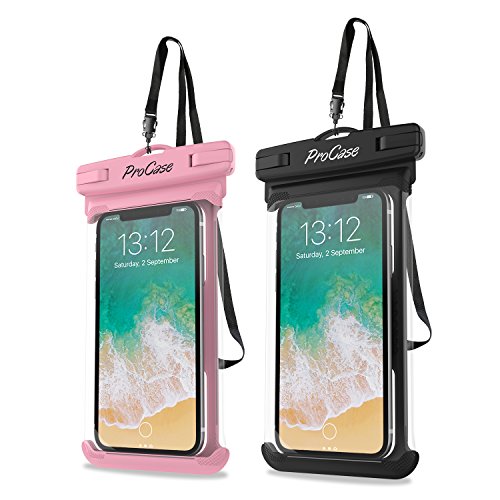
- RatingIPX8 certified, 100 ft
- Fitup to 7 in diagonal
- Accessside design for the phone's side buttons
- Screenclear windows front and back
- Sealupgraded snap lock
- Contents2 pouches in two colors with lanyards
Best for: Underwater photos and video, where the shutter button matters
This is the non-floating ProCase, and it exists for one reason: the side access. Underwater the touchscreen is useless, and the volume key is how you take a photo, so a pouch that lets you press it is a different tool from one that does not.
Beyond that it is a solid IPX8 pouch to 100 feet with clear windows front and back, an improved snap lock and two units in the box. If you want the same thing with buoyancy, the floating version above is the pick.
Pros
- The side design lets you press the volume keys, which is the underwater shutter
- Windows on both sides, so the rear camera shoots clean
- The upgraded lock opens and closes more easily than the older ProCase design
- Also holds cards and cash
Cons
- Seven inches, so large phones lose their case
- It does not float, unlike its floating sibling above
- More expensive than the Newppon four-pack for half as many
- RatingIPX8 certified, 100 ft
- Floatsyes
- Fitlarge phones, iPhone Pro Max and Galaxy Ultra class
- Screenclear windows front and back
- Carrylanyard plus reflective armband
- Sealsnap and lock
Best for: Running, fishing and swimming, where the bag has to stay strapped to you
Takfox covers the case the rest of this list ignores: the bag has to stay attached while you move. A lanyard swinging off your neck is fine on a boat and useless on a run, and the reflective armband here handles that, plus the visibility that comes with running in the dark.
The pouch itself is conventional and generous, rated IPX8 to 100 feet, floating, and sized for the largest current phones instead of the seven inch limit most cheap pouches quote.
Pros
- The reflective armband is the only one in this list, and it is the right carry for running
- It floats and is rated to 100 ft
- Sized for the big phones rather than the 7 in limit most rivals use
- Clear on both sides for photos and video
Cons
- A single pouch at ten dollars, where rivals give two
- An armband adds bulk if you only ever use the lanyard
- The band's reflectivity fades with washing

- RatingIPX8 certified, 100 ft
- Fitup to 7 in diagonal, 3.35 x 6.69 in device
- Window3.2 x 6.37 in, front and back
- Sealsnap and lock
- Carryneck strap
- Extrasroom for cards and cash
Best for: A spare that lives in the beach bag and gets used once a summer
The JOTO is the baseline every other pouch on this page is measured against. It has been sold in this form for years, it is IPX8 to 100 feet, and it costs about seven dollars.
What you give up is fit and buoyancy. Up to seven inches with the case off, no floating, and a plain neck strap. As the pouch that sits in the beach bag for the day somebody unexpectedly needs one, that is entirely sufficient.
Pros
- Around seven dollars, the cheapest single pouch here
- IPX8 to 100 feet, the same stated rating as pouches costing twice as much
- Clear on both sides for photos
- A long-running design with a large installed base
Cons
- Seven inches means a large phone goes in without its case
- Single pouch, no floating claim
- The neck strap is basic compared with the adjustable lanyards elsewhere

- Typerigid case, not a pouch
- Materialultra-clear shatterproof polycarbonate
- Sealgasket with a durable latch closure
- Outside7.25 x 4.25 x 0.75 in
- Inside6.75 x 3.75 x 0.5 in
- Protectionmoisture, impact and crushing
Best for: A kayak deck or a pack where the phone would otherwise get sat on
This is the only entry that is not a pouch, and it answers a different question. A phone in a soft bag at the bottom of a kayak is still a phone that can be knelt on; a polycarbonate box with a gasket and a latch is not.
The trade is obvious as soon as you hold it. You cannot use the phone while it is inside, there is no IP number quoted, and it takes up real space. As a dry box for a phone, a key and a card while you paddle, it is the sturdiest thing in this list.
Pros
- Shatterproof polycarbonate protects against impact, which no pouch here does
- The gasket and latch are a mechanical seal you can see is closed
- Rigid walls keep the phone from flexing under a load
- Holds a phone plus keys and cards without pressure on the screen
Cons
- No touchscreen use, since you cannot operate the phone through the shell
- No IP rating or stated depth is given
- It does not float, and it is bulky in a pocket
Checklist: What Makes a Great Waterproof Smartphone Bag
- Waterproof Rating: Prioritize a bag with an IPX8 rating, the industry standard for waterproof cases, which guarantees protection in water depths of at least 30 meters, ensuring your device's safety during most water-related activities.
- Size Compatibility: Select a bag that comfortably fits your smartphone. Consider cases compatible with screen sizes up to 8 inches to accommodate a range of devices, from small phones to large phablets.
- Durability: Look for strong and resilient materials like PVC or TPU in the construction of the bag, as these materials are known for their ability to withstand harsh environments and provide long-lasting protection.
- User-Friendly Design: A bag that offers a clear, touch-responsive interface allows seamless interaction with your smartphone, especially for underwater photography or essential communications.
- Secure Closure System: Assess the locking mechanism; it should be airtight and reliable, such as snap-and-lock closures or magnetic seals, to ensure a watertight bag even during active use.
- Practicality: Look for additional features such as adjustable lanyards, buoyancy, and room for extra items. These enhance wearability and convenience and ensure your smartphone is both secure and accessible.

FAQ
Are waterproof smartphone bags reliable for underwater photography?
Yes, high-quality waterproof smartphone bags allow for clear underwater photography while keeping your device dry and secure.
What should I look for when choosing a waterproof smartphone bag?
Choose a waterproof smartphone bag with an IPX8 rating, suitable size compatibility, durable material, user-friendly design, secure closure, and practical features like an adjustable lanyard.
Can I operate my phone's touchscreen while it's inside a waterproof bag?
Yes, most waterproof smartphone bags are designed with a clear, touch-responsive interface allowing seamless interaction with your phone’s touchscreen.