Eight waterproof fanny packs compared on how well each one seals, what fits inside and how the belt sits while you move.
Every pack in this list is in stock on Amazon right now, and every spec below comes from the manufacturer. The stated depths run from 3 to 32 feet, and that number is the whole decision: a pack that survives a splash at a pool is not the same product as one you can take under with a snorkel.
Waterproof fanny pack: the eight picks at a glance
People search for a waterproof fanny pack for swimming, for kayaking and for snorkeling, and those are three different requirements. Swimming means the pack goes under repeatedly, so the seal matters more than the size. Kayaking means it stays on deck and gets splashed, so a large waterproof fanny pack with room for a phone, keys and a wallet wins. Snorkeling means depth, and only the packs that state a figure in meters are worth trusting there.
An IP68 waterproof fanny bag is the common label, but IP68 on its own does not name a depth or a duration. Where the manufacturer states one, it is in the table below. Four of the eight also float, which is what saves the pack rather than the phone inside it.
- The all-rounder most people should buyDrench Waterproof Fanny Pack
- Best everyday belt bag that still submergesBooe Waterproof Belt Bag
- Deepest stated rating, and a two-packRynapac IPX8
- The budget pick for a beach weekHEETA 2-Pack


| Pack | Rating and depth | Size or capacity | Floats | Best for |
|---|---|---|---|---|
| Drench Waterproof Fanny Packbest overall | IPX8, 4 m for 30 min | Fits most smartphones | Yes | Swimming, SUP and snorkeling |
| Booe Waterproof Belt Bagbest everyday pick | IP67, 1 m for 30 min | Phone pocket plus main compartment | Yes | Wearing on and off the water |
| FROSTY PEAKS Waterproof Fanny Packlargest capacity | Full submersion, DryCore build | Large internal compartment | Not stated | Kayaking, fishing and hiking |
| Rynapac 2-Packdeepest rating | IPX8, 10 m (32 ft) | Outer pocket fits 8.5 in phones | Not stated | Snorkeling and jet ski use |
| HEETA 2-Packbest value | IP68, triple seal | 9.0 x 6.7 in, 3.6 oz | Yes | A beach week for two people |
| AiRunTech Waterproof Fanny Packcheapest single pack | Triple zip lock to 32 ft | 8.5 x 5.8 in | Yes | Cruise and beach days |
| Crenova 2-Packcheapest per pack | IP68, 4.9 ft for 30 min | Compact, phone and cards | Yes | Pool and beach basics |
| NASA AirLock 2-Packthickest material | IP68, swim safe | 350 micron PVC, large phones | Not stated | Heavy use in and out of water |
The eight waterproof fanny packs in detail
- RatingIPX8
- Depthsubmersible to 4 m for 30 minutes
- Zipperheavy-duty airtight, dry diving suit technology
- Floatsyes
- Fitsmost smartphones, plus cards and keys
- Useswimming, boating, SUP, snorkeling
Best for: Anyone whose pack is going to spend real time under water rather than beside it
This is the pack to buy if you actually swim with it. Most waterproof fanny packs seal with a fold-over flap and a strip of velcro over a zip lock, which works until the fold is not quite right. Drench uses an airtight zipper of the type used on dry diving suits, and states the result as IPX8 to four meters for thirty minutes.
It floats, which matters more than people expect. A sinking pack turns a dropped phone into a lost phone regardless of how well it seals. For kayaking, snorkeling and paddle boarding this is the one in the list with the least to argue about.
Pros
- The airtight zipper is the same principle as a dry suit, which is a different mechanism from a fold-and-velcro closure
- Four meters for thirty minutes is a stated figure, not a bare IP number
- It floats, so a dropped pack stays on the surface
- Touchscreen use through the front panel means the phone stays sealed
Cons
- Around 37 dollars, three times a basic two-pack
- One pack, where several rivals here give you two
- Sized for a phone and essentials, not for a large waterproof fanny pack load
- RatingIP67, fully sealed and submersible
- Depth1 m for 30 minutes
- ZipperTRU Zip airtight seal
- Floatsyes
- Phonededicated pocket with a clear back panel
- Wearwaist, crossbody or sling
Best for: Anyone who wants one bag for the beach and for the walk into town afterwards
The Booe answers a complaint that applies to every other pack on this page: they look like what they are, a sealed plastic bag on a belt. This one is built like a normal belt bag and is still IP67 and fully submersible.
The trade is depth. One meter for thirty minutes covers a pool, a shallow snorkel and any amount of rain, but it is not the pack for a dive. What you get instead is something you keep wearing when you leave the beach, with an airtight TRU Zip closure and a dedicated phone pocket you can still use through.
Pros
- It looks like a normal belt bag, not a clear plastic pouch, so it works off the water too
- The TRU Zip airtight zipper seals without a velcro flap over it
- Dedicated phone pocket with a clear panel, so the screen still works
- Floats if it goes over the side
Cons
- Around 74 dollars, the most expensive pack in this list
- One meter for thirty minutes is the shallowest stated depth here
- A single bag at the price of four budget packs

- ConstructionDryCore waterproof build
- Protectionrain, splashes and full submersion
- Capacitylarge internal compartment for phone, passport and keys
- Strapfully adjustable, waist or across the body
- Buildreinforced seams and secure closures
- Usekayaking, fishing, hiking, camping, festivals
Best for: Kayaking and fishing, where the pack carries more than a phone and a card
FROSTY PEAKS is the pick when the problem is volume rather than depth. The compartment takes a phone, a passport, keys and a wallet at once, which is what a waterproof fishing belt pack or a day on a kayak actually needs.
The build backs that up with reinforced seams and closures instead of the thin PVC film used at the bottom of this field. The gap in the spec sheet is the number: the manufacturer claims full submersion without naming a depth or a time, so treat it as a splash and dunk pack rather than a snorkel pack.
Pros
- The largest single compartment here, so a passport and a wallet go in alongside the phone
- Reinforced seams and closures rather than a thin PVC pouch
- The strap is long enough for waist or crossbody wear over a jacket
- Rated for full submersion, not just splashes
Cons
- Around 50 dollars, and it is a single pack
- No stated depth or duration, only full submersion
- No floating claim, so a drop over the side is a risk

- RatingIPX8
- Depthsubmersible to 10 m (32 ft)
- Designdouble layer, transparent outer pocket
- Phonefits up to 8.5 in, full touchscreen use
- Belt1.5 in wide, elastic on one side, nylon on the other
- Fitwaists from 31 to 51 in
Best for: Snorkeling and jet ski use, where the pack goes deep and stays wet
Rynapac states the number everyone else avoids: submersible to ten meters, which is thirty-two feet. That covers snorkeling and the kind of accidental depth a jet ski produces.
The double-layer construction is the other reason to pick it. The transparent outer pocket takes the phone and stays touchscreen-friendly for large models, while the inner space keeps cash and cards separate. The belt is wider than most at 1.5 inches, with an elastic section that stops it digging in.
Pros
- Ten meters is the deepest stated figure in this list
- The double-layer design separates the phone from the cash and cards
- A 1.5 inch belt with an elastic section is more comfortable than a flat nylon strap
- Two packs for around twenty dollars
Cons
- No floating claim
- The manufacturer asks you to water-test it before every serious use, which is telling
- Transparent outer pocket scuffs over time
- RatingIP68
- Seal3 zipper locks plus a fold-over velcro top
- Size9.0 x 6.7 in
- Weight3.6 oz
- Materialscratch-resistant PVC
- Strap22 to 33 in, fits waists 32.6 to 44.9 in
Best for: A beach week or a cruise, where two packs beat one
This is the volume answer. Two packs, IP68, a genuine three-stage closure, and about thirteen dollars for the pair. Nine by 6.7 inches is enough for a large phone plus a passport, which is more than most pouches at this price manage.
The seal is the part to be careful with. Three zip locks and a velcro fold work, but they work because you close them properly. HEETA, like every brand here, asks for a water test with a paper towel inside before you trust it with a phone.
Pros
- Nine by 6.7 inches is the roomiest of the cheap pouches, and it takes a 7 inch phone
- Triple zip lock plus a velcro fold is a genuine three-stage seal
- At 3.6 oz you forget it is there
- Two packs for around 13 dollars, and one is clear, one opaque for privacy
Cons
- No stated depth, only the IP68 label
- The velcro fold has to be done correctly every time or the seal is not a seal
- PVC pouches stiffen in cold water
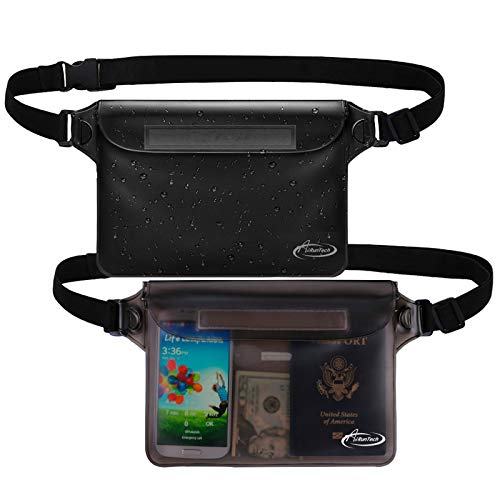
- Sealtriple zip lock
- Depthstated to 32 ft (10 m)
- Size8.5 x 5.8 in
- Floatsyes
- Paneltranslucent, touchscreen friendly
- Strapadjustable, fits about 33.5 in and up
Best for: A cruise or a beach day where the pack holds a phone, an ID and cash
The AiRunTech pairs a deep stated rating with a floating build for around twelve dollars, which is an unusual combination this far down the price list. Thirty-two feet covers anything a snorkeler is likely to do.
It is smaller than the HEETA, so it is a phone-and-documents pack rather than a wallet-and-sunscreen one. The manufacturer states the same instruction the others do: test the seal before you use it, and check the closure for damage each time.
Pros
- Thirty-two feet is the deepest figure in this list alongside the Rynapac
- It floats, unusual at around twelve dollars
- The translucent panel lets you answer a call without opening it
- Wide adjustment range on the strap
Cons
- At 8.5 by 5.8 in it is smaller than the HEETA for a similar price
- Triple zip lock without an airtight zipper, so the seal depends on you
- Translucent PVC yellows with sun exposure

- RatingIP68
- Depthbelow 4.9 ft for around 30 minutes
- Sealtriple zip locks plus a velcro strip
- Floatsyes
- Materialscratch-resistant PVC, touchscreen friendly
- Contents2 packs
Best for: A pool, a beach or a boat day where the pack is not going deep
Crenova is the floor of this market and it does the basics honestly. Two packs, IP68, and a stated limit of about 4.9 feet for thirty minutes rather than a vague claim.
That limit is the thing to read. It is enough for a pool, a paddle or a wave breaking over you, and it is not enough for a dive. What it does very well is keep sand and dust out, which on a beach is the more common way a phone dies.
Pros
- Two floating IP68 packs for around ten dollars, the cheapest entry here
- Crenova states an actual figure, 4.9 ft for about 30 minutes
- Also blocks dust, dirt and sand, which is what kills phones on a beach
- Compact and light enough to wear under a shirt
Cons
- Under five feet is the second shallowest stated depth in this list
- Compact, so a passport is a squeeze
- Same fold-and-velcro dependency as the other budget pouches

- RatingIP68, swim-safe design
- SealAirLock seal, tested 72 hours with zero ingress
- Material350 micron certified PVC film
- Belt1.5 in elasticated, tensile-tested to 55 lbs
- Fitslarge and small phones
- Contents2 packs, one black, one clear
Best for: Heavy, repeated use where thin pouches tear at the seam or the belt stretches
This one is sold on thickness. Most cheap waterproof pouches use thin PVC film that tears at a seam after a season; this uses a certified 350 micron film and states a 72-hour seal test with no ingress.
The belt is the other upgrade. A 1.5 inch elasticated hip belt tensile-tested to 55 pounds is more than a beach pouch needs, and it is exactly the component that stretches and lets the pouch flap on the ones that cost half as much. The missing piece is a depth figure, so treat it as a swim pack rather than a snorkel pack.
Pros
- At 350 microns the film is noticeably thicker than the standard budget pouch
- The belt is tensile-tested to 55 lbs, which is the part that usually fails first
- A 72-hour zero-ingress test is a longer claim than any other seal here
- Two packs, one clear for touchscreen use and one opaque for privacy
Cons
- No stated depth, only the IP68 label and a swim-safe claim
- No floating claim
- Around 19 dollars, more than the Crenova or HEETA pairs
Checklist: What makes a great Waterproof Fanny Pack
- Material Durability: Key for longevity, opt for waterproof fanny packs made from robust materials like PVC, Polyester, or TPU, which are known for resisting tears and punctures while keeping contents dry.
- Water Resistance: Essential for protection against the elements, look for features such as IP68 certification, and double Zip-Lock or Velcro closures which indicate a fanny pack's ability to withstand submersion and heavy rainfall.
- Seal Effectiveness: Verify the sealing mechanism, as a triple-seal closure can enhance waterproof capabilities, providing an essential barrier that safeguards against any water ingress during underwater activities.
- Size and Fit: Consider fanny packs with adjustable belts to ensure a secure fit for various body sizes and activities. The size should be ample enough to accommodate essentials without being bulky.
- Design Versatility: Review the fanny pack's adaptability to different styles of wear such as over the shoulder or across the chest, which offers flexibility for different outdoor and water-related adventures.
- Eco-Friendly Options: For the environmentally conscious, options constructed from eco-friendly materials provide a sustainable choice without compromising on water resistance or durability.

FAQ
Can waterproof fanny packs be submerged in water?
Yes, waterproof fanny packs designed for submersion can protect valuables underwater, often up to specific depths, like 32 feet.
Are waterproof fanny packs suitable for activities beyond water sports?
Absolutely, waterproof fanny packs are versatile, suitable for hiking, cycling, and travel, protecting contents from water and dust.
How do I ensure my waterproof fanny pack is properly sealed?
Check for features like IP68 certification and a triple-seal closure, which indicate effective waterproofing capabilities to safeguard against water ingress.