Eight yoga paddle boards compared on deck space, stability and how much of the board is padded for practice.
A yoga board is not just a wide board. What separates one is the deck pad: it has to run far enough forward and back that a hand can land where a hand lands, not stop at a small traction patch under your feet. Every board below is one the maker sells for yoga and gives a soft, full-width pad.
Yoga paddle boards: the eight picks at a glance
Width is the first number to read, because a board at 33 in is a different practice surface than one at 35 or 36 in. The second is weight capacity: the more of it you have left over above your own weight, the higher the board floats and the less it rocks when you shift onto one side.
Below you get the short version first: four picks for the most common cases, then the full table with all eight, then every board in detail with specs, strengths and weaknesses.
- The wide, well-equipped all-rounderBluefin Aura Fit
- Built specifically for yogaRetrospec Weekender Yogi
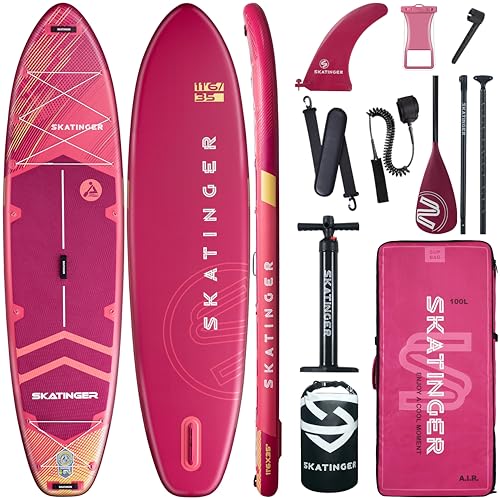
- Widest platform hereSkatinger 11 ft 6 in by 35 in
- Cheapest board that still says yogaDAMA Premium Yoga and Pets


| Board | Size | Capacity | Deck | Best for |
|---|---|---|---|---|
| Bluefin Aura Fitbest overall | 36 in wide | Up to 353 lbs (160 kg) | Mandala print pad with a central lotus | Yoga plus a full accessory package |
| Retrospec Weekender Yogi 10 ft 8 inbest yoga-specific | 10 ft 8 in, extra wide | not stated | No-slip textured pad, widened nose and tail | Practice first, paddling second |
| Advanced Elements Lotus Yoga 10 ftstiffest build | 10 ft, 6 in thick | not stated | Large traction foam area | Riders who want a rigid, double-skin board |
| Skatinger 11 ft 6 in by 35 inwidest platform | 11 ft 6 in x 35 in x 6 in | Up to 450 lbs | Non-slip EVA pad, dual bungee | Two people, or one and a dog |
| Flypark 11 ft by 35 inwide on a budget | 11 ft x 35 in x 6 in | Up to 430 lbs | Marine-grade PVC, three handles | The same width for less money |
| DAMA Premium Yoga and Petscheapest yoga deck | 33 in wide | Up to 330 lbs | Yoga-patterned soft deck plus pet EVA | A first board, and a dog on the nose |
| DC DICLASSE 11 fthighest pressure | 11 ft | not stated | No-slip soft EVA deck | Riders who want 14.5 psi of stiffness |
| AISUNSS 10.6 ft by 33 inlightest here | 10.6 ft x 33 in x 6 in | Up to 450 lbs | Soft anti-slip EVA deck | Carrying it alone to the water |
The eight yoga paddle boards in detail
- Width36 in, the widest board in this list
- Capacityup to 353 lbs (160 kg)
- Fins2 plus 1 with a Smartlock system
- Builddense drop-stitch with multi-layer Exo Surface lamination
- Deckmandala pattern with a central lotus print
- Warrantyfive years
Best for: Anyone who wants the widest deck here and a complete kit, and does not mind paying for it
The Aura Fit is the board this list is built around. Thirty-six inches of width is the practical difference between a board you balance on and one you can move around on, and the mandala deck with its lotus print is not decoration alone: it marks out where the pad runs, which is what you actually stand and kneel on.
Construction is the other reason it sits first. A dense drop-stitch core under multi-layer Exo Surface lamination is what keeps a 36 in board from flexing in the middle, and flex is what turns a stable board into an unstable one under load. Bluefin backs it with a five year warranty and ships it with the full accessory package rather than a bare board.
Pros
- At 36 in it gives you more practice surface than anything else in this list
- A 353 lb capacity leaves plenty of float above an adult, which is what keeps the board from rocking mid-pose
- The 2 plus 1 fin setup holds a line while you paddle out and comes apart without tools
- Sold with the Deluxe package: fiberglass paddle, coiled leash, quick-inflation pump, phone case and backpack
Cons
- It is the most expensive board here by a wide margin
- Bluefin sells it directly rather than through Amazon, so returns run through their shop
- The board is heavier to carry than the 19 to 20 lb boards further down
- Length10 ft 8 in, extra wide
- Shapewidened nose and tail for stability
- Deckno-slip textured pad, spacious and soft
- BuildAerGlide-Lite puncture-resistant construction
- Weight19.7 lbs
- In the boxdual-action pump, rucksack, three-piece paddle, fins, leash
Best for: Someone whose main use is practice on the water rather than distance paddling
This is the board on the list built for the thing the page is about. Retrospec widened both the nose and the tail rather than just the middle, which is the difference that matters once you go into a pose that puts your weight over one end of the board.
The deck pad is soft and textured across a large area, so a hand or a knee lands on grip rather than on bare PVC. The trade for the outline is glide: a wide, blunt board is slower to paddle anywhere. If your session is mostly practice with a short paddle out and back, that trade is the right way round.
Pros
- Retrospec designs and sells this one as a yoga board, so the deck and the outline are built for the job
- A widened nose and tail is exactly what keeps the board level when your weight moves off center
- At 19.7 lbs it is light enough to carry to the water and back without help
- Everything needed is in the box, including a three-piece adjustable paddle
Cons
- A widened outline paddles slower than a pointed touring shape
- The maker gives no weight capacity figure
- At around 320 dollars it costs more than twice what the budget boards here cost

- Length10 ft
- Thickness6 in high-pressure drop-stitch
- Decklarge traction foam area
- Skindouble layer outer skin
- Widthextra wide for added stability
- In the boxpump with pressure gauge, duffel bag with shoulder straps
Best for: Riders who want a rigid board that holds its shape and are willing to pay for the construction
The Lotus is the engineering answer rather than the size answer. Ten feet is short for a yoga board, but 6 in of high-pressure drop-stitch under a double layer skin gives you a platform that does not sag in the middle, and sag is what makes a board feel tippy long before width does.
What you give up is length and, with it, glide and tracking. What you get is a board that feels the same on the last day of the season as on the first. The pump with a gauge is a small detail that belongs on every board in this class and is not on most of them.
Pros
- High-pressure drop-stitch at 6 in thick is the stiffest construction claim in this list
- The double layer outer skin is what separates a board that lasts from one that softens after a season
- A large traction foam area, rather than a small pad, is the point of the model
- The pump has a pressure gauge, which is the only way to know you actually reached working pressure
Cons
- It is the most expensive Amazon board here at over 550 dollars
- At 10 ft it is the shortest board in the list, so it tracks less well on a longer paddle
- Advanced Elements state no weight capacity and no exact width
- Size11 ft 6 in x 35 in x 6 in
- Capacityup to 450 lbs, rated for three people
- Fin10 in US-box center fin
- Decknon-slip EVA pad
- Storagesix-point bungee at the front, four-point at the rear
- Extrasthree handles, 1680D backpack, shoulder strap
Best for: Practice with a partner or a dog aboard, and anyone who wants the most surface for the money
The Skatinger is the floor-space option. Thirty-five inches wide and 11 ft 6 in long gives you roughly the footprint of a yoga mat with room around it, and the 450 lb capacity means the board is still floating high with two adults on it.
The 10 in US-box fin is worth noting because it is the part most boards at this price skimp on. It keeps the board tracking straight instead of wandering, which matters when you are paddling a wide board that already wants to turn. The dual bungee sets front and rear give you somewhere to put a bag and a bottle.
Pros
- 35 in of width against the usual 32 in, which the maker calls out directly as a yoga and family feature
- 450 lbs of capacity is the highest stated figure in this list alongside the AISUNSS
- A 10 in US-box fin holds a straight line better than the small fins on cheaper boards
- Four central D-rings take a kayak seat, so the board has a second use
Cons
- A board this wide is slow and hard work to paddle into wind
- 11 ft 6 in of rolled board is a big load for the backpack
- The kayak seat the D-rings are made for is not included

- Size11 ft x 35 in x 6 in
- Capacityup to 430 lbs
- Weight19.8 lbs
- Fins9 in center fin plus two 7 in side fins, tool-free
- Materialmarine-grade PVC, sand, saltwater and UV resistant
- Extrasthree handles, 110L backpack, three-piece paddle 67 to 77 in
Best for: Anyone who wants a 35 in yoga platform without paying the Skatinger price
Flypark builds the same shape as the Skatinger, 35 in wide and 11 ft long, and sells it for less. The maker lists yoga in the product name, and the width is the part of a yoga board that actually decides whether the practice works.
The three-fin setup is tool-free, with a 9 in center fin for tracking and two 7 in side fins for bite in wind. At 19.8 lbs it is easier to carry than its size suggests. What you do not get is the yoga-first deck layout of the Retrospec, so check that the pad reaches as far as your hands do.
Pros
- The same 35 in width as the board above for meaningfully less money
- At 19.8 lbs it is one of the lightest boards here despite its size
- The tool-free three-fin setup goes on and off without a screwdriver on a windy beach
- 430 lbs of capacity covers two adults or an adult with gear
Cons
- It is sold as a family and fishing board first, so the deck is not laid out around a practice
- Marine-grade PVC is a weaker construction claim than the double-skin and drop-stitch boards above
- Nothing in the listing states the deck pad length

- Width33 in
- Capacityup to 330 lbs
- Materialmilitary ultra-light PVC drop-stitch
- Deckyoga-patterned soft deck with extra EVA at the nose for pets
- Extrassport camera mount on the nose, extra steel D-rings
- Setupabout 10 minutes to inflate, 5 to deflate
Best for: A first yoga board, especially if a dog rides along on the nose
The DAMA is the way in. It costs a fraction of the boards above it and still commits to the category: the deck is patterned and laid out for yoga rather than being a plain traction strip, and there is a separate EVA area at the nose for a dog.
Where it gives ground is size. Thirty-three inches and 330 lbs is enough for one adult practicing alone, and not much more than that. The factory camera mount and the extra steel D-rings are the kind of detail more expensive boards leave off.
Pros
- The cheapest board in this list and still built around a yoga deck rather than a generic pad
- Extra EVA at the nose gives a dog grip where it would otherwise slide
- A camera mount on the nose is fitted from the factory, no adhesive pad needed
- Drop-stitch PVC keeps it stiff, and the extra D-rings make it easy to tie off or carry
Cons
- At 33 in it is narrower than the 35 in boards here, so there is less room to spread out
- A 330 lb capacity is the lowest here, which limits practicing with a second person aboard
- Inflating it takes roughly ten minutes by hand

- Length11 ft
- Pressure14.5 psi working pressure
- Materialmilitary-grade PVC with improved sealing
- Deckno-slip soft EVA with cushioning
- Findetachable center fin
- In the boxadjustable paddle, coiled ankle leash, pump, backpack
Best for: Riders who care more about how stiff the board feels underfoot than about maximum width
The DC DICLASSE trades the width race for pressure. At 14.5 psi the board inflates harder than most boards at this price, and a hard board is a stable board: what makes people wobble is usually flex under the feet rather than a lack of inches.
The deck is soft EVA over the full padded area, which the maker points out cushions a fall as well as adding grip. That is the right emphasis for a yoga board. The gap in the listing is the numbers: no width, no capacity, so you are buying on construction claims alone.
Pros
- A 14.5 psi rating is higher than most boards in this price class and is what makes a board feel solid
- The soft EVA deck is thick enough to cushion a knee or a fall, not just to add grip
- 11 ft of length tracks better than the 10 ft boards here
- The maker lists yoga first among the uses the board is built for
Cons
- No stated width or weight capacity, which makes it hard to compare directly
- A single detachable fin, where most boards here give you three
- Rated pressure only helps if you own a pump with a gauge

- Size10.6 ft x 33 in x 6 in
- Capacityup to 450 lbs
- Weight19 lbs
- Materialmilitary-grade PVC drop-stitch
- Decksoft anti-slip EVA
- Setupabout 5 minutes to inflate or deflate
- Finsone large removable fin plus two small ones
Best for: Anyone who carries the board any distance and wants a yoga deck at the low end of the price range
The AISUNSS is the light one. Nineteen pounds is the difference between a board that goes to the water and one that stays in the garage, and it still carries a stated 450 lb capacity, which is the highest figure in this list.
The compromises are the usual ones at this size and price: 33 in of width rather than 35, and a short 10.6 ft hull that needs its big center fin to hold a line. For a solo practice on a calm lake, and especially for anyone carrying gear alone, that is a reasonable place to land.
Pros
- 19 lbs is the lightest board in this list, and weight is what decides whether you actually go
- 450 lbs of capacity on a 10.6 ft board means it floats high under one person
- Five minutes to inflate or deflate is quick for a 6 in board
- The maker sells it as a meditation and yoga board, with a soft anti-slip EVA deck
Cons
- At 33 in it is on the narrow side for practice, like the DAMA
- 10.6 ft is short, so it wanders more than the 11 ft boards when you paddle
- Nothing in the listing describes how far the deck pad runs
Checklist: What makes a great Yoga Paddle Board
- Stability: A wide and stable design is crucial for practicing yoga poses on water. Ideal boards are often broader at the nose and tail, which enhances balance and prevents tipping.
- Size & Capacity: Your paddle board should be large enough to comfortably accommodate your yoga poses. A sizeable length and width, as well as a high weight capacity, guarantee a spacious and supportive practice area.
- Build Material: Look for durable construction with features such as military-grade PVC, dense drop-stitch patterns, and resilient coatings to ensure your board withstands the rigors of regular use.
- Deck Pad: A non-slip EVA deck pad is essential to ensure grip during yoga practices. The pad should provide a comfortable surface that's gentle on your body while maintaining a firm hold.
- Portability: Consider boards that are easy to transport, both inflated and deflated. Features like lightweight design, carry handles, and an included backpack or carrying bag are beneficial.
- Accessory Package: A complete accessory set including a pump, paddle, leash, and possibly a kayak seat or camera mount adds value and convenience, offering a fully equipped start to your SUP yoga journey.

FAQ
What should I look for in a yoga paddle board?
For yoga on a paddle board, prioritize stability with a wide design, durable build material, ample deck space, non-slip pad, and high weight capacity for a secure practice area.
How does stability affect yoga on a paddle board?
Stability is key for paddle board yoga as a stable board ensures balance and focus without the distraction of wobbling, making it easier to transition through poses.
Can I use a regular paddle board for yoga?
Yes, but a yoga-specific paddle board with features like a non-slip deck pad and wide design enhances stability and comfort for practicing yoga on the water.